


Bahrām Himeh’s Literary Career Examined at the “Balkh Nights”
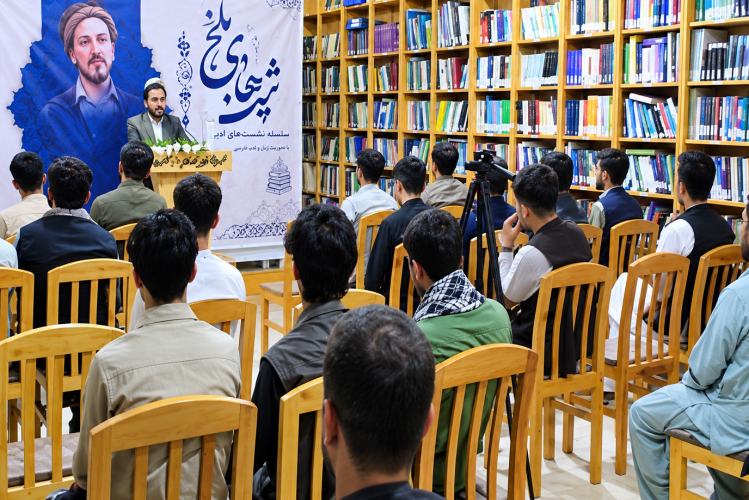
According to the Saadi Foundation’s Public Relations Office, during the gathering, Seyyed Eskandar Hosseini Bamdad, director of the Ferdowsi Library in Mazar-e-Sharif, highlighted the significance of Persian Poetry and Literature Day and its coincidence with the anniversary of the death of the renowned Iranian poet Ostad Shahriar. He described the Persian language as one of the most important cultural links connecting past, present, and future generations.
He said that the Persian language connects the thoughts of today’s generation with a rich heritage of literary and cultural figures, including Rumi, Saadi, Hafez, Ferdowsi, Bedil, Rudaki, Sanai, Omar Khayyam, Khwaja Abdullah Ansari, and Rabia Balkhi.
Referring to the historical role of Balkh, Herat, and Ghazni in the formation and expansion of the Persian language and literature, Hosseini Bamdad added that safeguarding the Persian language means safeguarding the identity and civilizational and historical heritage of Persian-speaking peoples.
The researcher and cultural activist then examined the literary career of Bahrām Himeh, describing him as a distinguished and talented poet in the field of contemporary Afghan ghazal.
He noted that Himeh, by drawing on indigenous roots, making use of the potential of the language, and employing a form of archaism, while combining fluent language with social issues and cultural concerns and integrating them with romantic themes, has succeeded in establishing a notable position in contemporary Afghan ghazal.
Speaking at the event, Seyyed Ruhollah Hosseini, Cultural Counsellor of the Islamic Republic of Iran and representative of the Saadi Foundation in Afghanistan, stressed the need to identify and support literary talents during the stages of their growth and development.
He described the honoring of Bahrām Himeh, a young Afghan poet, on Persian Poetry and Literature Day as a valuable initiative, saying: “The Persian language is a living and dynamic heritage of a civilization and has a vast capacity for expressing human emotions and concepts with precision.”
Referring to the interest of writers and researchers from different countries in learning Persian, Hosseini said that enthusiasts and researchers from countries such as the United Kingdom, Germany, France, and countries in South America have turned to learning Persian in order to read the works of poets such as Rumi, Hafez, and Saadi in their original language.
The Saadi Foundation’s representative in Afghanistan also referred to the naming of Persian Poetry and Literature Day in commemoration of the anniversary of Ostad Shahriar’s death, saying that Shahriar, an Azerbaijani-speaking poet, is an example of the capacity of the Persian language to attract and nurture diverse talents, and that his ghazals clearly demonstrate this capacity.
Elsewhere in his remarks, referring to certain pessimistic tendencies in the poetry of some contemporary young poets, he said that great poets such as Saadi, Hafez, and Rumi created enduring works during some of the most difficult periods in history, including the era of the Mongol invasion.
Hosseini emphasized that despair and a sense of helplessness should not dominate a poet’s poetry and thought, adding that today’s poets should look toward the future and move toward inspiring hope and fostering creativity and growth.


Your Comment :